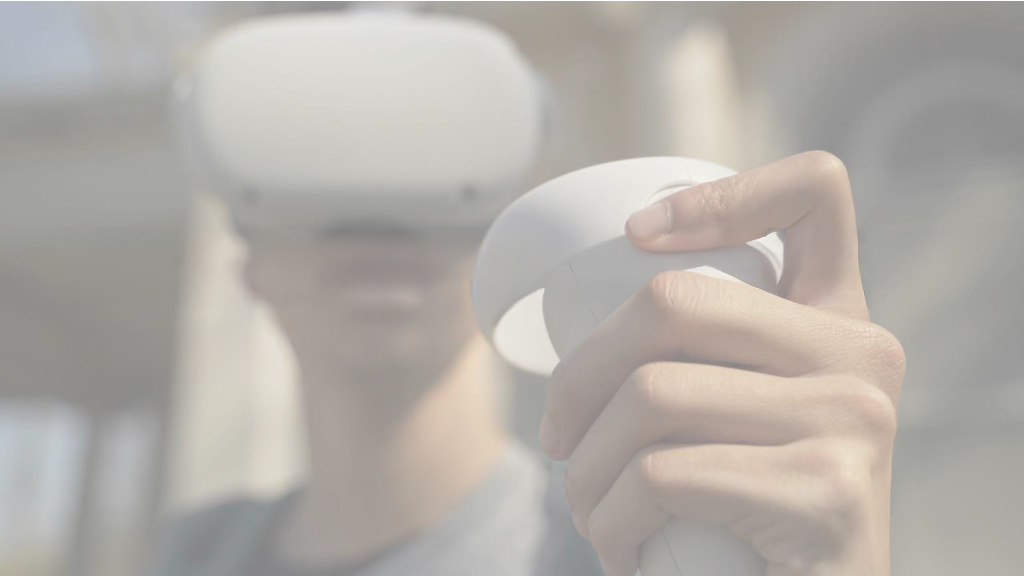
Image of student participant in Virtual Reality (VR)
The Potential of Virtual Reality as a Tool to Connect Social Science and Design Research: A Case Study of Implicit Bias in Virtual Interactions
Master of Design Thesis | Cincinnati, Ohio, 2023
Background
This work is a Master’s Thesis for the Master of Design program at the University of Cincinnati, encompassing design research, a public thesis defense presentation, and a published thesis paper.
Research Question
How might we connect Social Science and Design Research?
Abstract
This study explores the intersection of social science and design research using virtual reality (VR) to experience virtual spaces. The purpose of this study is to investigate how visual bias is replicated in virtual spaces using photorealistic virtual characters from Metahuman to determine if the appearance of the virtual character affects the comfort level of participants in VR scenarios. A sample of 16 college students participated in VR scenarios with virtual characters displaying different weight and gender. The level of comfort with each virtual character was measured using self-reported comfort level, heart rate, and distance. The results, though not statistically significant, suggested that, as hypothesized, participants felt more comfortable with Metahumans that displayed low weight and a gender match with the participant. This study also highlights the potential of using VR to model interactions that would otherwise be difficult or impossible to recreate in physical scenarios. Finally, this study also provides recommendations for the use of VR in future research.